
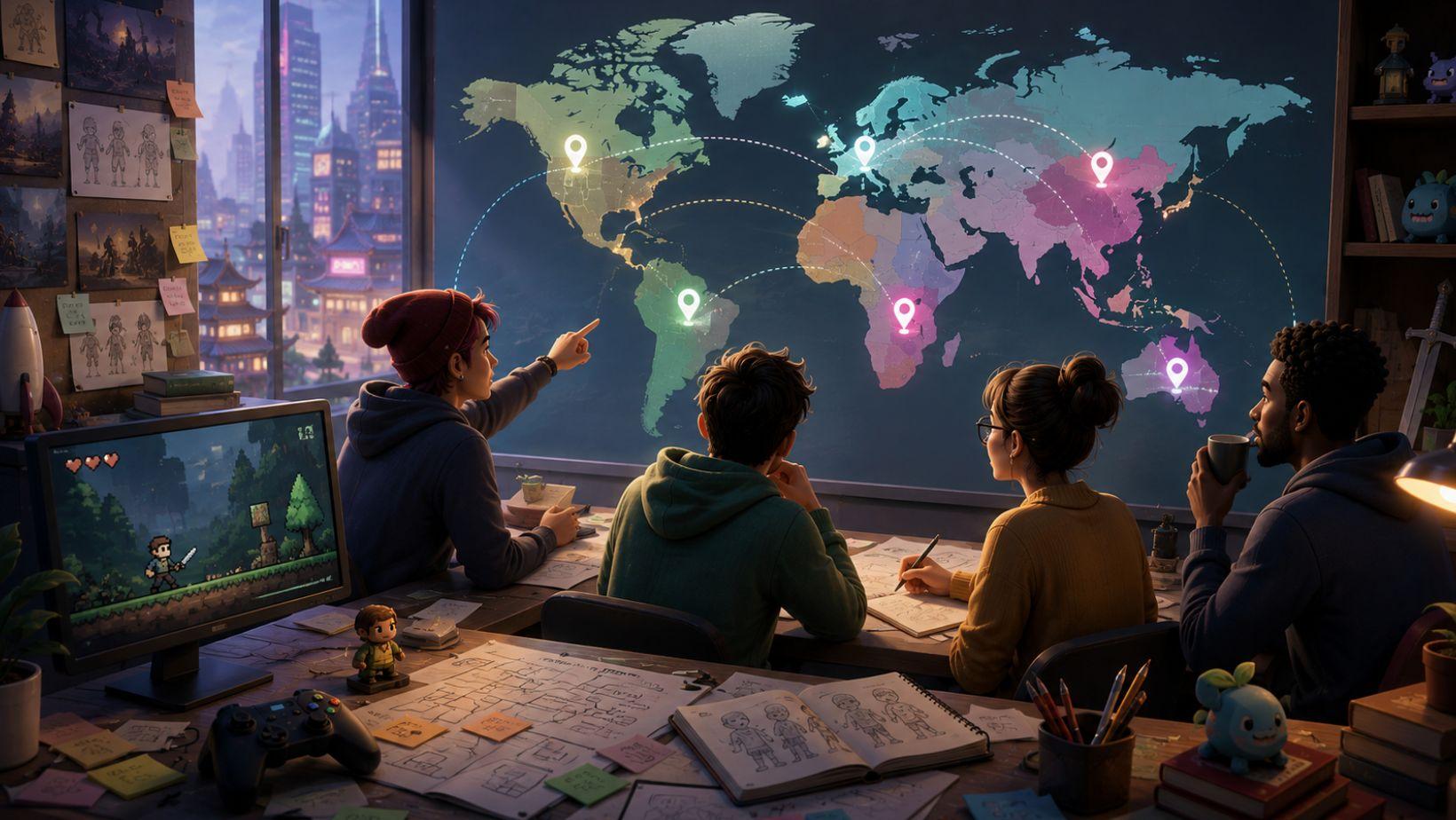
Key Takeaway: International revenue often exceeds domestic revenue for successful indie games – but only for studios that treat localization as an engineering discipline planned from pre-production, not as a launch-week scramble bolted onto a finished English build.
TL;DR: Indie studios entering global markets need to plan across five layers: text translation, voice-over, cultural adaptation, regulatory compliance, and linguistic QA. Producers who succeed build continuous localization workflows during production, prioritize five high-ROI languages (Simplified Chinese, Brazilian Portuguese, Latin American Spanish, Russian, German), and treat translation memory as a compounding long-term asset. Retrofitting localization after launch costs 3-5x more than building it in from day one.
Every indie studio dreams of the international breakthrough – the game that finds an unexpected audience in Japan, or Turkey, or Brazil, and multiplies revenue several times over. What most producers underestimate is that this outcome is almost never accidental. The indie games that reach global players consistently share one pattern: their producers built localization into the project as an architectural decision, not as a post-launch experiment.
The gap between hopeful and successful international launches usually comes down to a few operational choices made early in production. Producers new to this territory will find Crowdin’s guide to video game localization a useful starting reference – it walks through the end-to-end process from initial planning through launch, and covers the file formats, integration patterns, and cultural considerations that anchor modern game localization programs.
What follows is a producer-focused playbook that condenses the strategic decisions and operational patterns behind successful international indie releases in 2026 – the market opportunity, the five layers of localization every producer must plan, the step-by-step process for building a roadmap, common mistakes, honest cost frames, and answers to the questions producers ask most often.
The International Opportunity: Why Indie Studios Can’t Ignore It
The global gaming market in 2026 is more geographically distributed than ever. English-speaking markets – US, UK, Canada, Australia – represent roughly 30 percent of global gaming revenue. The remaining 70 percent is spread across dozens of markets where English-only games consistently underperform relative to localized versions.
Four out of the top five gaming markets by revenue in 2026 are non-English: China, Japan, South Korea, and Germany. Brazil, Russia, and Turkey have all become significant growth markets for indie titles specifically, with regional players actively seeking games in their native languages on Steam and mobile stores. An English-only indie game effectively concedes the majority of its potential revenue before launch.
The economic case is easiest to see through Steam data. Wishlist growth in non-English markets accelerates significantly once a Steam page is localized – often by 2-4x in the first quarter after localization. Retention curves in localized regions bend upward compared to English-only baselines. Review scores in localized markets tend to be higher, which feeds Steam’s discovery algorithms and produces additional organic reach.
The counter-argument – “we’ll localize later once we know the game succeeds” – sounds prudent but usually kills the opportunity. By the time an indie studio has clear signals of international demand, it has already lost the launch window when localized visibility mattered most.
The 5 Layers of Game Localization Every Producer Must Plan
Localization operates across five distinct layers, each with different economics, timelines, and quality thresholds.
The temptation for indie producers is to focus on layer 1 and skip everything else. This is the mistake that produces the most international launch failures. All five layers matter – but they matter proportionally to the game’s genre, scope, and target markets.
Step-by-Step: Building a Localization Roadmap for Indie Studios
Step 1: Pre-production – architectural decisions
Before feature development begins, choose your engine’s localization approach, standardize on a file format for strings (Unity .po, Unreal .csv, JSON, ARB), and set up externalized string files from the first commit. Retrofitting these patterns later is exponentially more expensive.
Step 2: Early production – pipeline setup
Choose a localization platform, connect it to your source repository via webhook, and configure automatic string extraction. Set up translation memory and glossary as first-class project assets. Add pseudo-localization to your CI to catch layout bugs before real translations arrive.
Step 3: Mid-production – language prioritization
Choose your first five languages based on target market economics, not vanity. The five languages with consistently strong indie ROI are Simplified Chinese, Brazilian Portuguese, Latin American Spanish, Russian, and German. Japanese and French follow closely for narrative-heavy titles.
Step 4: Late production – translator onboarding
Bring translators into the project early. Give them access to builds, screenshots, character bios, and context documents. Translators working with real product context produce dramatically better output than translators working from isolated string exports.
Step 5: Beta – Linguistic Quality Assurance
Two weeks minimum. Native-speaking testers play through the main content in each supported language. File bugs. Fix bugs. Retest. Rushed LQA is the source of most launch-day localization disasters.
Step 6: Launch – coordinated release
Localized Steam pages, marketing copy, store screenshots, and launch trailers all ship together. Half-localized launches signal to international players that you don’t take their market seriously.
Step 7: Post-launch – continuous updates
Every patch and DLC flows through the same pipeline. Translation memory compounds value with every project.
Common Mistakes That Sink International Launches
Hardcoding strings during rapid feature development. Feature teams inline English text “temporarily” and promise to externalize it later. Later never comes, and the debt compounds. Lint rules that fail the build on hardcoded strings prevent this cleanly.
Providing translators no context. A translator working from a flat list of strings cannot produce quality translations for narrative content. In-context editing tools, screenshots, and playable builds all help.
Skipping culturalization for cost reasons. Machine translation and even professional linguistic translation miss cultural landmines that only native players from the target market recognize. Native cultural consultants remain essential for narrative-heavy games.
Under-investing in LQA. Studios that translate the game but never test the localized build catch bugs from angry player reviews rather than from internal QA. Even a two-week LQA pass on main story content catches most high-severity issues.
Treating localization as launch-week work. Studios that freeze English content and hand it off for translation two weeks before launch consistently ship broken international versions. Continuous localization is the only workflow that scales.
How Much It Actually Costs
Cost transparency is rare in indie localization discussions, but the ranges are knowable. Actual costs depend on word count, quality tier, machine translation usage, and voice-over scope, but the following frames apply for most indie projects.
Text-only localization per language:
Voice-over per language:
- Small indie (limited VO): $2,000-$10,000
- Full character VO: $10,000-$50,000
- Full dubbing (narrative-heavy): $50,000-$200,000+
LQA per language: $500-$8,000 depending on scope
Cultural consultation per market: $500-$3,000
Machine translation with human post-editing can reduce text costs by 40-70 percent compared to fully human translation, at the cost of some quality on narrative content. Most indie studios use MT-plus-post-editing for routine content and full human translation for story-critical dialogue.
The strategic question isn’t “how much does localization cost” but “what’s the ROI on each language for this specific game.” A game that costs $5,000 to localize into German and produces $30,000 in additional revenue from German-speaking markets has clear positive ROI. A game that costs $30,000 for a market that will earn $8,000 does not.
Frequently Asked Questions
When should indie game localization begin?
Ideally, during pre-production. Externalizing strings and choosing localization file formats are architectural decisions that should be made before feature development. Retrofitting localization into a mature codebase is significantly more expensive than building it in from day one.
Which languages should indie studios prioritize first?
The five languages with consistently strong ROI for indie games are Simplified Chinese, Brazilian Portuguese, Latin American Spanish, Russian, and German. These markets have large gaming populations and reward localized content with higher wishlist rates and stronger retention. Japanese and French follow closely for narrative-heavy titles.
Can indie studios rely on machine translation?
Only partially. AI translation handles routine content – UI strings, help articles, item descriptions – with high accuracy. Character dialogue, emotional beats, and culturally sensitive material still benefit substantially from human translators. The dominant model in 2026 is AI-first drafting with human refinement on story content.
How long does indie game localization take?
For a small-to-mid indie game with 30,000-50,000 words across five languages, expect 4-8 weeks with continuous localization workflows. Larger narrative titles with full voice-over across ten or more languages can require 4-8 months. Continuous workflows compress these timelines significantly compared to batch translation.
What is Linguistic Quality Assurance (LQA)?
LQA is the process of playing through the localized build to catch translation errors, formatting issues, context bugs, and cultural adaptations that fail in-game. Native-speaking testers play the game in each supported language and file bugs against the localized version. It is the last line of defense before international players see the game.
Do indie studios need voice-over localization?
Not necessarily. For most indie games, high-quality localized subtitles produce better outcomes than low-quality voice-over. Full VO localization only makes economic sense for narrative-heavy titles targeting AAA-tier markets. Otherwise, invest the VO budget in more text languages or better cultural consultation.
Conclusion
International success for indie games is not a lottery. It is the predictable outcome of producers who treat localization as an engineering discipline, plan for it from pre-production, invest in the operational pipeline that connects translation to release, and commit to the ongoing work of updating localized content as the game evolves. In a global gaming market where two-thirds of revenue lives outside English-speaking regions – a distribution that industry research from Newzoo has tracked consistently for over a decade – this is one of the highest-leverage strategic decisions an indie producer can make, and one of the few where the cost of moving early is small and the cost of delay is enormous.