

A few years ago, a standard performance marketing campaign followed a predictable, albeit slow, rhythm. You would commission a “hero” asset—perhaps a high-gloss 30-second video or a meticulously staged product shot—and put the bulk of your budget behind it. If it worked, you were a hero. If it didn’t, you were back to the drawing board for three weeks of reshoots and editing.
Today, that model is effectively dead. Social platform algorithms, particularly on Meta and TikTok, have become “creative hungry” at an unprecedented scale. They don’t just want one good ad; they want twenty variations of that ad to see which hook resonates with a specific micro-audience. The bottleneck in modern marketing isn’t the media buy—it’s the production of the creative itself. This is where the integration of specific generative models, like Nano Banana Pro, is fundamentally shifting the role of the creative strategist from a “maker” to an “orchestrator.”
The Death of the ‘Hero’ Asset Strategy
The primary challenge for performance marketers today is creative fatigue. Even a winning ad has a shelf life that is significantly shorter than it was three years ago. When an audience sees the same visual hook repeatedly, click-through rates plummet and customer acquisition costs (CAC) spike. To combat this, teams have traditionally tried to “brute force” variation by hiring more editors or outsourcing to high-volume agencies.
The manual labor required to produce even a simple variation—say, changing the background of a lifestyle shot from a modern apartment to a rustic cabin—used to take hours of masking and compositing in traditional software. Early generative AI tools offered a glimmer of hope, but they often failed marketers by producing “hallucinated” versions of products or images that looked beautiful but lacked any brand-specific control.
Marketers don’t need “art”; they need assets that adhere to a specific visual hypothesis. If you believe your product sells better to suburban parents than urban professionals, you need a way to test that theory in hours, not weeks. The shift toward a high-velocity iteration pipeline requires tools that prioritize speed and structural consistency over pure artistic novelty.
Establishing a Visual Baseline with Nano Banana Pro
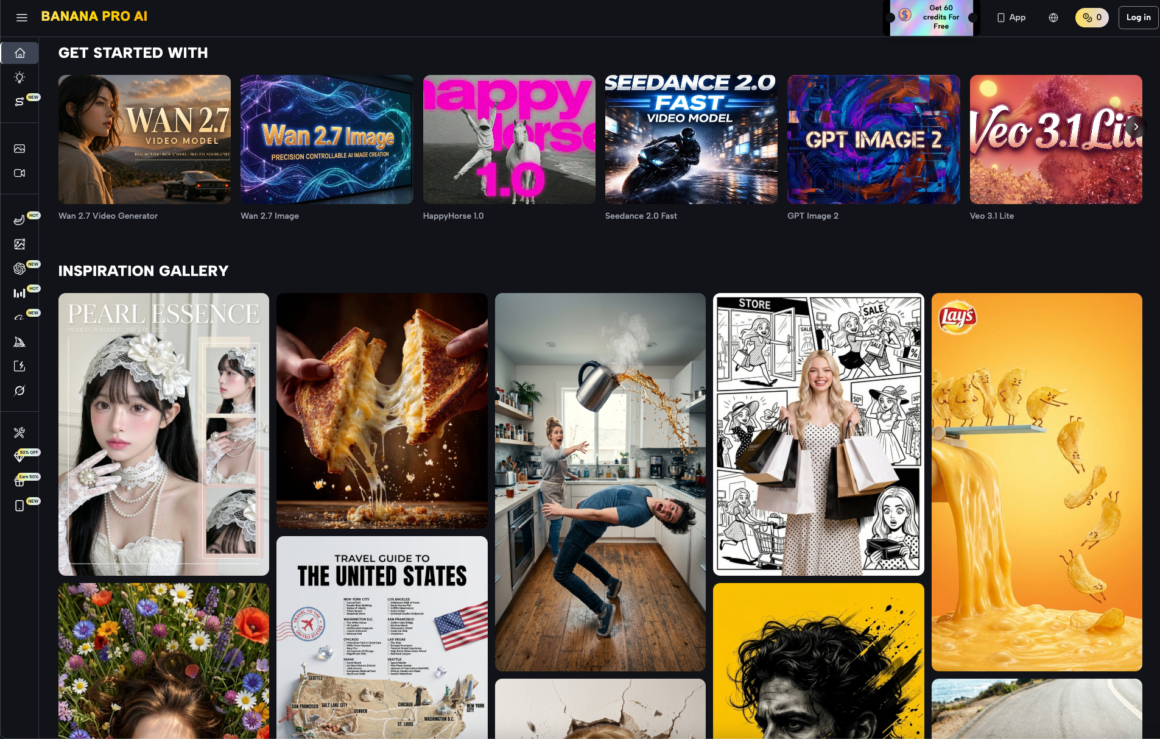
The first step in a modern AI-driven creative workflow is establishing a baseline. This is where the Nano Banana Pro model and the broader Banana AI ecosystem come into play. Instead of starting with a blank canvas or an expensive photoshoot, marketers are using these models to generate high-fidelity base images that serve as the “scaffolding” for a campaign.
Using Nano Banana Pro allows for what we call “wide-net” prompting. In the time it would take a designer to search stock photo sites for five relevant images, an operator can generate fifty distinct aesthetic directions. This isn’t about finding the final ad; it’s about discovering the visual hook. You might prompt for different lighting styles, varied color palettes, or diverse casting choices to see which “vibe” aligns with your campaign’s core themes.
However, there is a necessary moment of uncertainty here: even with advanced models like Nano Banana Pro, the first generation is rarely the “final” generation. It is a mistake to expect an AI to deliver a pixel-perfect, brand-ready asset on the first click. The model provides the raw material—the high-resolution, high-context visual—that must then be refined through a more surgical editing process.
Surgical Iteration via the AI Image Editor
Once a baseline image is selected, the workflow shifts from generation to modification. This is perhaps the most critical stage for a performance marketer. A single “winning” image is actually a liability if you cannot replicate its success across different segments.
The AI Image Editor allows for a canvas-based workflow where local edits take precedence over global changes. For example, if you have a high-performing image of a person using your app, you don’t want to re-generate the entire scene to test a new background. You want to keep the subject—the “anchor” of your creative—and swap the environment.
This level of control is what separates professional marketing tools from recreational AI generators. By using image-to-image techniques and local inpainting, a marketer can iterate on specific variables (like the time of day, the presence of a pet, or the color of a shirt) while maintaining the core composition. This drastically reduces the feedback loop between a performance manager’s request and the creative team’s output.
It is important to note a limitation in current technology: total spatial consistency. While the AI Image Editor is incredibly powerful for swaps and additions, ensuring that a product maintains the exact same dimensions and perspective across ten different background generations still requires a keen human eye. AI can still struggle with the subtle physics of shadows and contact points, and a “floating” product can immediately destroy the trust of a potential customer.
Moving from Static Hooks to Video Motion
If a static image performs well in initial testing, the next logical step in the iteration pipeline is adding motion. Video remains the dominant format on social platforms, but high-quality video production has always been the most expensive hurdle for small to mid-sized teams.
By leveraging the Nano Banana models within a video generation framework, marketers are now animating their winning static concepts into 5-second “scroll-stoppers.” These aren’t cinematic masterpieces with complex narratives; they are high-impact clips designed to capture attention in the first 1.5 seconds.
The strategy here is focused on “micro-motion.” You take a static ad that is already converting and add subtle movement—steam rising from a coffee cup, clouds moving behind a house, or a slight camera pan around a product. This allows you to validate the cost-per-result (CPR) of video content against your static baselines without the overhead of a full production crew.
However, expectations must be managed regarding AI video. Current generative video technology is excellent for texture and atmosphere, but it is notoriously difficult to control for specific, choreographed movements (like a person perfectly unboxing a product). For most marketers, AI video is best used for atmospheric background motion or high-concept visual effects rather than literal product demonstrations.
The Realities of AI-Driven Ad Pipelines
While the speed of these tools is transformative, a successful AI-driven ad pipeline requires a heavy dose of skepticism and grounded reasoning. We are currently in a transition period where the “uncanny valley” remains a significant risk. If an AI asset feels “too artificial,” it can trigger a subconscious distrust in the consumer, particularly in high-trust niches like healthcare, finance, or luxury goods.
There are three key areas where marketers must exercise caution:
- Typography and Branding: Most generative models, including Banana Pro, are still unreliable when it comes to rendering specific, legible text or complex brand logos within an image. Smart marketers generate the visual “plate” using AI and then layer their typography and branding using traditional design tools.
- Brand Integrity: AI is prone to drifting away from brand-accurate color grading if not strictly monitored. A “Coca-Cola Red” or a “Tiffany Blue” must be precise; “close enough” is usually a failure in professional contexts.
- Algorithmic Sentiment: There is ongoing uncertainty regarding how social platforms will eventually treat AI-heavy content. While current algorithms prioritize engagement above all else, there is always the possibility of future “AI-generated” labels or deprioritization of content that lacks human metadata.
Systematizing the Creative Feedback Loop
The ultimate goal of using tools like Banana Pro is to build a system where data directly informs creative output. In a traditional setup, the creative team is often insulated from the performance data. In an AI-enabled setup, the person looking at the Facebook Ads Manager is often the same person tweaking the Nano Banana prompts.
This redefines the role of the “Creative Strategist.” This person is no longer just a manager of people, but an orchestrator of models. They look at the data—perhaps seeing that “outdoor” backgrounds are outperforming “indoor” backgrounds by 30%—and immediately jump into the editor to generate ten more outdoor variations.
Scaling creative output no longer requires scaling headcount. It requires a refined workflow where the engine of production is decoupled from the manual constraints of the past. As we move forward, the competitive advantage in performance marketing will not belong to those who can make the “best” ad, but to those who can iterate through a hundred variations the fastest to find the one that actually works.
The velocity of variation is the new metric of success. By treating AI not as a magic “make ad” button, but as a high-speed engine for testing visual hypotheses, marketing teams can finally keep pace with the voracious appetite of modern digital platforms.